To operate a Fiat-to-Digital Asset platform, whether it is an On-Ramp, Exchange, or Cross-Border Payment app, you effectively have one banking strategy: the Omnibus Account.
Opening a segregated bank account for every single user is an operational dead end. Beyond the crushing unit economics of maintaining thousands of accounts, the compliance burden of KYC’ing every end-user directly with your banking partner would grind onboarding to a halt. To operate at scale, you have to pool funds into shared “For-Benefit-Of” (FBO) accounts, also known as omnibus accounts.
In a standard fintech environment, this is manageable. You typically map thousands of user balances to a single asset (USD) sitting in one or more omnibus accounts in a single pool. All your reconciliation happens in one place.
For hybrid platforms—businesses that bridge the gap between traditional banking and blockchain networks—this model breaks down. You are not just managing one asset in one place. You are managing a split state across two incompatible worlds. On one side, your cash sits in bank accounts constrained by banking hours. On the other, your digital assets sit in wallets that move instantly at all times of day.
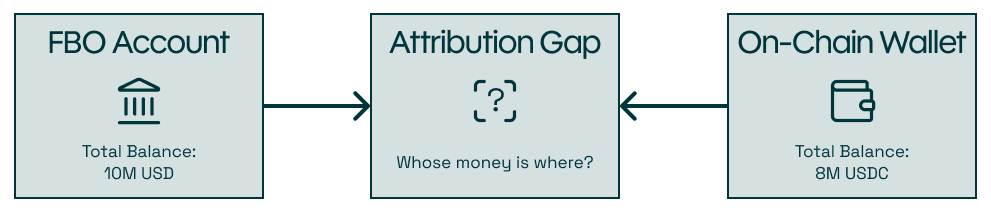
This split creates a unique “Omnibus Trap.” You have one pool of assets and one pool of inventory, but they are rarely in sync. The bank statement says one thing, the blockchain says another, and your internal ledger is stuck in the middle trying to guess the truth.
This article breaks down how to design a Core Ledger that manages this fragmented omnibus structure without losing track of your money.
The Attribution Problem
The fundamental issue with this split architecture isn’t just that the money moves at different speeds. It is that your banking partners and blockchain providers have no idea who your users are.
You are operating two distinct types of anonymous containers: Fiat FBOs (like a pooled account at JPMC holding everyone’s USD) and Digital Asset Wallets (like a Fireblocks hot wallet holding everyone’s USDC).
When you look at your JPMC bank portal, you see a single number: 10,000,000 USD. You do not see “Ben has 50 USD” or “Alice has 100 USD.” You just see the pile.
If you rely on that single number, you are flying blind. If the balance drops to 9,999,900 USD, you know you are missing 100 USD, but you have no idea whose 100 USD it is. Did a wire bounce? Did a digital asset withdrawal double-spend? Was it a fee?
This is where the standard model breaks. You cannot solve a specific user’s problem (like a bounced wire) if your ledger only tracks the generic pool. To operate safely, your Core Ledger must bridge the gap between the commingled funds at the bank and the individual balances of your users.
The Solution: Virtual Segregation
It’s best not to view your Omnibus Accounts as a single account, but to treat is as a view.
The mistake most platforms make is trying to mirror the bank’s reality (one big account) in their internal ledger. That forces you to maintain a separate “User Balance” table and constantly reconcile the two.
The better architectural pattern is Virtual Segregation. You don't track the Omnibus as a generic pool; you track it as the aggregate of thousands of specific user paths.
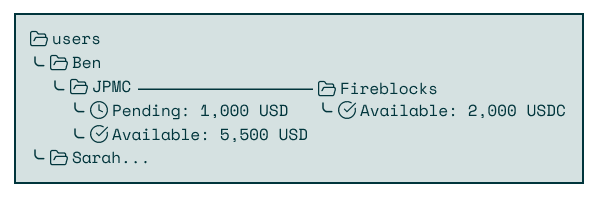
In this model, we use Hierarchical Paths to name our accounts, similar to a file system on a computer. Instead of a flat list of random IDs, we structure the account name to represent exactly where the money sits. A typical path follows the logic of Entity:Location:State. This tells you who owns the funds, which physical rail holds them, and whether they have actually arrived.
This results in account names that tell a story:
•user:ben:JPMC:pending (State: Unsettled | Risk: High) This holds the 1,000 USD wire Ben just initiated. It’s visible, but it isn't “real" money yet.
•user:ben:JPMC:available (State: Settled | Risk: None) This holds Ben’s fiat from past transactions that have already cleared into your FBO.
•user:ben:fireblocks:available (State: On-Chain | Risk: None) This holds Ben’S USDC sitting in the on-chain wallet, ready for withdrawal.
Why Hierarchical Paths Work
This structure essentially turns your account names into a query language. Because the data is hierarchical, you can answer complex questions just by summing different segments of the path.
Want to know Ben's total balance? Sum everything starting with user:ben:*. You get his total net worth across all banks and blockchains combined.
Need to verify the JPMC Omnibus? Sum everything containing *:JPMC:available. This gives you the total settled cash that should be in your bank account right now, automatically ignoring any pending wires.
Want to see your total risk exposure? Sum everything ending in *:pending. This tells you exactly how much “phantom money” is currently moving through the system that hasn't settled yet.
By encoding the Identity and State directly into the account path, you eliminate the need for complex reconciliation scripts. You isolate the “time risk” (pending vs. settled) into its own bucket, allowing you to treat uncollected funds differently from settled cash without guessing.
Operational Logic: The Happy Path vs. The Unhappy Path
The hierarchical structure we defined isn’t just for reporting; it controls how money moves. This is critical for managing the Settlement Gap, the dangerous window where you front digital assets from your Treasury before the user's wire actually clears.
In a double-entry system, funds cannot appear out of thin air. They must originate from outside your ledger. We model this external source as "World." This concept allows us to distinguish between unverified funds entering from the banking system and the settled inventory safely sitting in your Treasury. The ledger's primary job is to manage the transition between the two.
Here is how that logic plays out in practice.
Scenario A: The Happy Path (Deposit & Withdrawal)
In this scenario, Ben wires 1,000 USD to us, uses those funds to buy USDC, and then successfully withdraws 1,000 USDC.
•Movement: World → user:ben:JPMC:pending
•Context: We record the incoming wire signal. The funds are attributed to Ben, but they are strictly tagged as “pending” because they haven't settled at the bank.
•Movement: platform:treasury:USDC → user:ben:fireblocks:available
•Context: The Platform fronts the trade. You move USDC from your corporate treasury to Ben's available balance so he can use it immediately.
•Movement: user:ben:fireblocks:available → World
•Context: Ben withdraws the crypto to an external address. The asset leaves the platform entirely.
•Movement: user:ben:JPMC:pending → platform:treasury:USD
•Context: The wire finally settles. We move the funds from Ben's pending bucket to the Platform’s Treasury to “pay back” the value we fronted in Step 2.
That’s the dream scenario where everything works. But in reality, wires bounce and settlements fail. Here is how the ledger handles the mess when things go wrong.
Scenario B: The Unhappy Path (Partial Withdrawal & Bounced Wire)
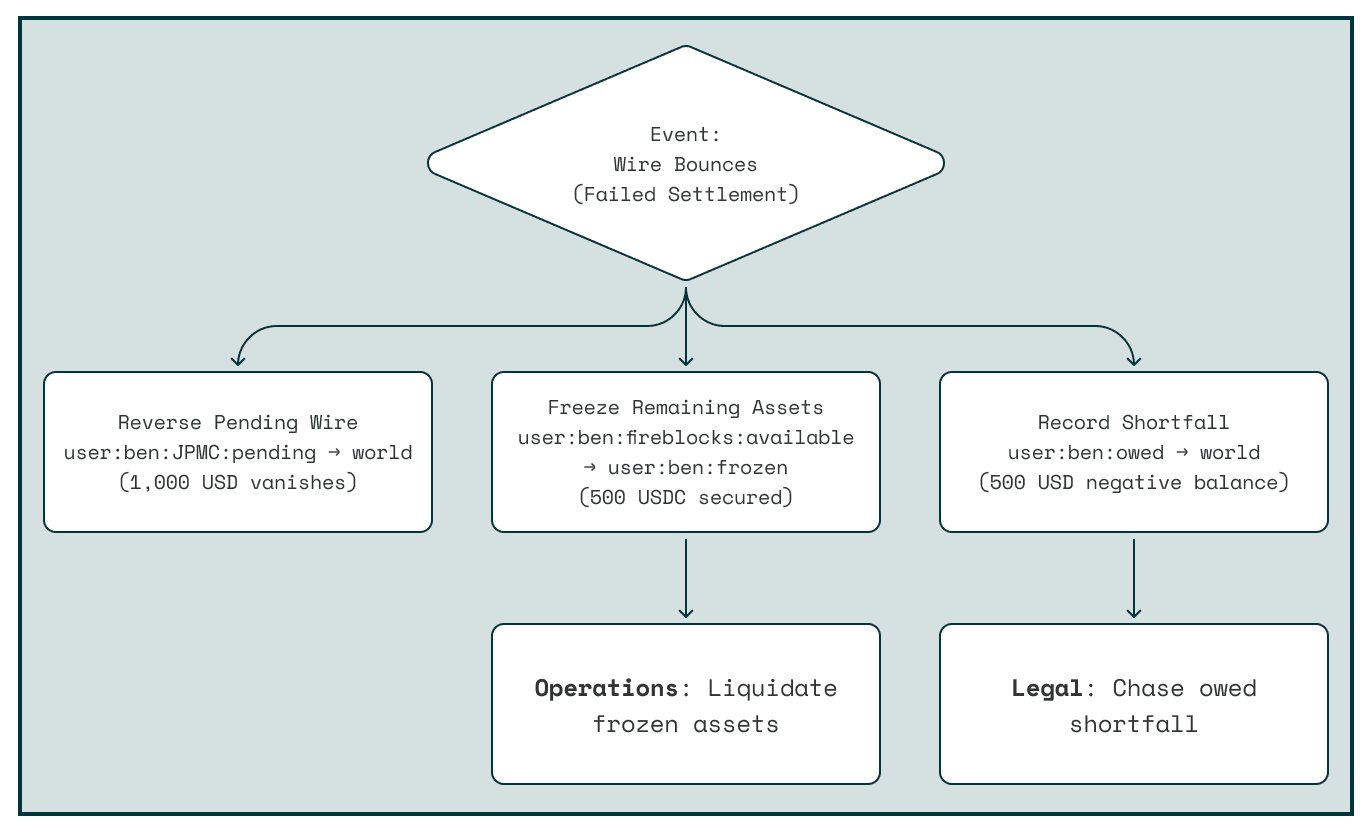
Consider a similar scenario where Ben bought 1,000 USD worth of USDC, withdrew 500 USDC of it to an external wallet, and then his 1,000 USD wire bounced.
If we simply deleted the transaction, our books would be wrong (the Treasury would be missing 500 USDC). Instead, we execute a Freeze & Recovery Workflow:
•Movement: user:ben:JPMC:pending → World
•Context: We reverse the incoming deposit record (1,000 USD). The pending funds effectively “disappear” back to the World because they never actually arrived.
4b. Freeze Remaining Assets
•Movement: user:ben:fireblocks:available → user:ben:frozen
•Context: We immediately move the remaining 500 USDC in Ben’s wallet to a frozen account. This secures the collateral we still control.
•Movement: user:ben:owed → world
•Context: This transaction represents the 500 USDC Ben withdrew but never paid for. By moving funds from his “owed” account to the World, we drive his balance to -500 USD. This negative balance represents the specific hole Ben left in the platform’s inventory.
This separation gives you a precise operational breakdown of the event. The positive balance in the frozen account (500 USDC) represents assets you have successfully secured and can return to the Treasury immediately. The negative balance in the owed account (-500 USDC) represents the actual realized loss from the withdrawal. Instead of a single confusing number, you have clear instructions for your teams: Operations liquidates the frozen funds, and Legal chases the specific shortfall in the owed account.
From Reconciliation to Verification
Once you have this level of definition, where every state (pending, settled, frozen) is explicitly tracked, reconciliation stops being a monthly “search and rescue” mission for missing money. It becomes a continuous, programmatic verification.
In a traditional setup, you wait until month-end to compare your database against the bank statement. With Virtual Segregation, you can assert the health of your platform in real-time.
Because we structured our accounts using Hierarchical Paths, we don’t need complex scripts to verify our books. We can simply run targeted checks against each physical rail:
•Fiat Check: Sum(*:JPMC:available) gives us the actual JPMC bank balance
•Digital Asset Check: Sum(*:fireblocks:available) gives us the actual Fireblocks wallet balance
Handling Fees & Drift
In a perfect world, these sums are always exact. In reality, network fees and operational costs create variance.
In a spreadsheet model, these fees are often treated as “noise” or “drift” that you just accept. In a Core Ledger model, you can track them explicitly.
Because you can create virtual accounts on the fly, you don't have to tolerate the discrepancy. When the blockchain reports a 0.00033 ETH gas fee, you don't just ignore it; you book it to a dedicated platform:operating:gasfees account.
This turns “drift” into data. Instead of asking “Why are we off by 50 USD?”, you can see exactly how much you are spending on network costs in real-time, keeping your reconciliation equation balanced to the penny.
By shifting to this model, you are no longer asking “Do our books match?” You are asking “Is the system healthy?” And you are getting the answer every minute.
Don’t Build This From Scratch
The architecture described in this article, covering hierarchical paths, double-entry enforcement, and programmable asset freezing, is the gold standard for Fiat-to-Digital Asset ramps.
However, there is a massive gap between designing this logic and maintaining it in production. While you could build this schema on top of a standard SQL database, you would effectively be rebuilding the wheel. You would need to architect complex double-entry constraints, write custom locking mechanisms to prevent race conditions, and build reconciliation logic from the ground up.
That is where Formance comes in. We provide this architecture as a set of pre-built, open-source primitives, so you don't have to manage the infrastructure yourself.
We give you a platform designed specifically for this complexity:
•The Programmable Ledger: An open-source, immutable log of transactions. It natively handles the hierarchical paths we described (user:ben:frozen), allowing you to create accounts on the fly just by naming them in a transaction.
•Numscript: A Domain-Specific Language (DSL) built for writing ledger transactions. Instead of hacking together SQL queries, you use Numscript to express complex movements, like the “Freeze & Recovery” workflow, in a safe, readable, and atomic format. •Reconciliation & Connectivity: A dedicated framework to ingest data from your banking partners (via Connectors) and automatically compare it against your internal ledger to detect drift in real-time.
If you are tired of fighting with spreadsheets to track your money, let’s talk about your ledger design!